Shelita Gutter's Posts

Joel Monroy, STEM Center Student Success

Posted

Former Members

Postdocs, Visiting Scholars, and Graduate Students:

1. Dr. Fengan Yu, Postdoc, Research Assistant Professor 2002-2006
PhD, Zhejian Agricultural University
[email protected]
Current: University of Michigan at Ann Arbor, USA

2. Li Xu, Technician 2001-2002
MS, Chinese Academy of Medical Sciences & Peking Union Medical University
[email protected]
Current: Henan University, China

3. Ravi S. Bojja, MS 2001-2004
BS, University of Hyderabad
[email protected]
Current: Max Planck Institute for Molecular Physiology, Dortmund, Germany

4. Yousong Ding, MS 2001-2004
BS. Peking Uinversity
[email protected]
Current: University of Michigan at Ann Arbor, USA

5. Suman Layek, 2001-2012
BS, University of Calcutta

6. Han Yi, MS 2001-2005
BS, University of Science and Technology of China
[email protected]
Current: University of Michigan at Ann Arbor, USA

7. Dr. Xiangcheng Zhu, PhD 2001-2007
BS, University of Science and Technology of China
[email protected]
Current:
Director of Microbiology Lab
Changsha Charisma Bioscience Co., Ltd, China
And: Department of Chemical Engineering and Bioengineering
Zhejiang University, Hangzhou, China

8. Dr. Kathia Zaleta-Rivera, Co-sponsored PhD 2002-2007
BS, CINVESTAV-IPN (National Polytechnology University), Mexico
[email protected]
Current: Department of Chemical Engineering, Stanford University, CA

9. Lorena Amaya Delgado, Visiting Scholar 2006
BS, CINVESTAV-IPN (National Polytechnology University), Mexico[email protected]

10. Wanbo Liu, 2005-2006
BS, Peking Uinversity
[email protected]

11. Prof. Zhangcai Yan, Visiting Scholar 2005
Current: National Natural Science Foundation of China
Division of Microbiology

12. Ryan Gerber, MS 2005-2008
BS, Bethel College, N. Newtow, KS
Current: Research Associate at Pioneer Hi-Bred, Johnston, IA

13. Dr. Ting Lin, Visiting Scholar 2007-2008, co-sponsored PhD 2009
BS, School of Life Sciences, Xiamen University, China
Current: Faculty, Medical School, Xiamen University, China

14. Dr. Yaoyao Li, Visiting Scholar 2008-2009, co-sponsored PhD 2010
BS, School of Life Sciences, Xiamen University, China
Current: Faculty, School of Medicine, Shandong University, China

15. Dr. Wenyan Xu, Visiting Scholar 2009-2010, co-sponsored PhD 2011
Current: Kunming Institute of Botany, Chinese Academy of Sciences

16. Prof. Mingzi Wang, Visiting Scholar 2011
Fujian Normal University, Fuzhou
Current: Associate Professor, Fujian Normal University, Fuzhou, China

17. Dr. Justin Huffman, PhD 2005-2012
BS, Pennsylvania State University, Altoona, PE
Current: Assistant Professor, Penn State University, Altoona

18. Dr. Wei Zhang, Visiting Scholar 2010-2012, co-sponsored PhD 2012
School of Life Sciences, Xiamen University, China
Current: Associate Professor, Qingdao Institute of Bioenergy and Bioprocess Technology, Chinese Academy of Sciences

19. Dr. Lili Lou, PhD 2007-2012
BS, East China Normal University, China
Current: Scientist, Celerion, Inc.

20. Dr. Yan Wang, Visiting Scholar 2010-2012, co-sponsored PhD 2012, Postdoc 2013-2014

BS, School of Life Sciences, Shandong University, China
Current: Associate Professor, The Ocean University of China

21. Dr. Peiji Zhao, Visiting Scholar 2012-2013
Current: Professor, Kunming Institute of Botany, Chinese Academy of Sciences

22. Dr. Liangxiong Xu, Visiting Scholar 2012-2013
Current: Associate Professor, South China Botanical Garden, Chinese Academy of Sciences

23. Stephen Wright, MS 2010-2013
BS, Wayne State University, Columbus, NE
Current: Vatterott College, Omaha, NE

24. Dr. Yunxuan Xie, PhD 2008-2013
BS, Nankai University, Tianjin, China
Current: Lecturer, Tianjin University

25. Dr. Haotong Chen, PhD 2009-2015
BS, Tianjin University, China
Current: Postdoc, Edison Biotechnology Institute, Ohio University, Athens


Undergraduate Students:

  • Jacob Robinson (University of Nebraska-Omaha, NSF REU student, summer 2015)
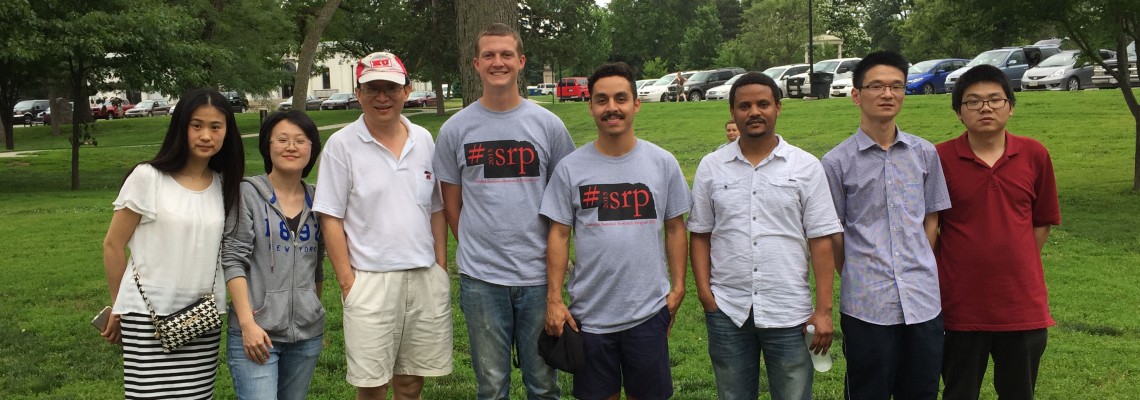
  • Joel Monroy (Pasadena City College, CA, NSF REU student, summer 2015)
  • Molly Miller (University of Nebraska-Lincoln, 2014-2015, now at UN Med School)
  • Feng Chen (University of Nebraska-Lincoln, 2014-2015)
  • Crystal Elenbaas (Dordt College, IA, 2014)
  • Samantha Medema (University of Nebraska-Lincoln, 2014)
  • Feng Chen (University of Nebraska-Lincoln, 2014)
  • Yinghua Luo (University of Nebraska-Lincoln, 2013-2014)
  • Yufan Zhou (Beijing Forestry University, 2012, now at graduate school at UC Davis)
  • Jason Schrad (NSF-REU, 2011, now at Macalester College, St. Paul, MN)
  • Mike Roth (NSF-REU, 2012, now at medical school at the University of Minnesota-Twin Cities )
  • Yurika Matsui (UCARE, now at the graduate school of Pennsylvania State University)
  • Matthew Zmudka (NSF-REU, now at the graduate program, Integrated Program in Biochemistry, at the University of Wisconsin-Madison)
  • Wenyu Qu (Vanderbilt University)
  • Andrew Marasch (UCARE, now at University of Nebraska Medical Center)
  • Joel Jorgenson (UCARE, now at Medical School of Northwestern University)
  • Chad Vogeler (UCARE, now at Thomas Jefferson Medical College at Philadelphia)
  • Bethany Calloway (NSF-REU)
  • Isis Arreguin (NSF-REU, now at the graduate school UNL)
  • Jeff Millet (NSF-REU, now at College of Pharmacy, University of Iowa)
  • Lucy Q Li (NSF, Washington University at San Luis)
  • Jayzonn Fu
  • Nate Hollman
  • Lizz Miller
  • Rachel Nelson

Read More →

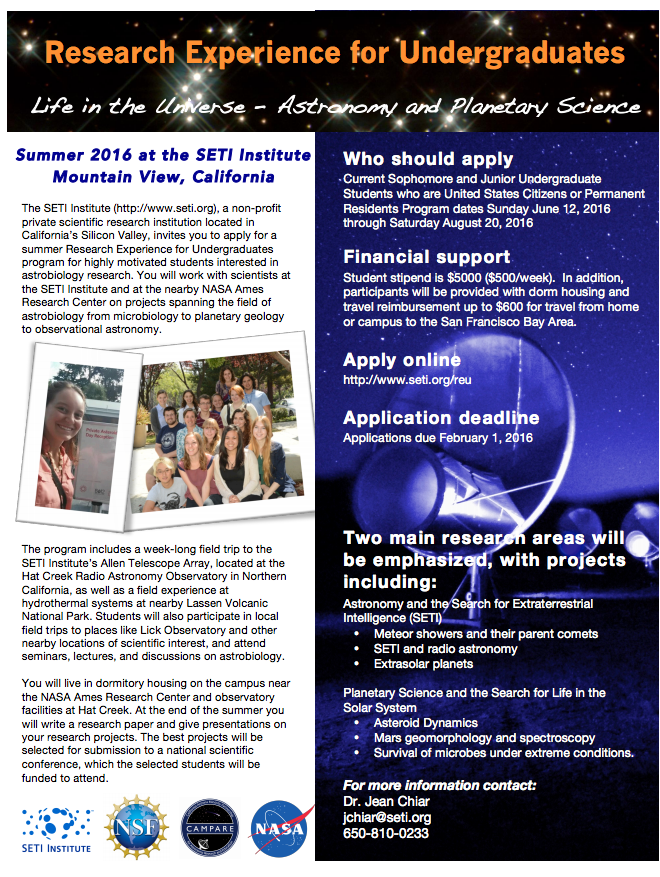
Research Experience for Undergraduates

Posted

Screenshot 2015-12-14 10.37.16

http://www.seti.org/seti-educators/reu


Read More →

Going with the flow: Biochemistry student lands research opportunity

buildpoder01web_damara_111915.jpg

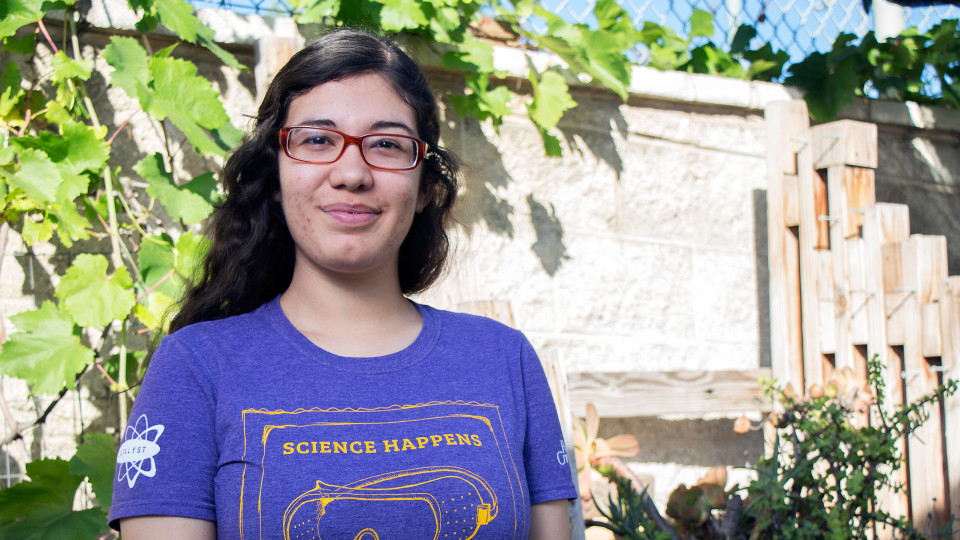
Keely Damara/Courier Michele Ramos, 22, a sophomore at PCC studying biochemistry sits in the Science Village patio garden at Pasadena City College on Friday, October 30, 2015. Ramos was selected by the BUILD PODER program to foster her research project on testing the differences between the water in her town of Hunington Park to that of Pasadena.

Share Button

“I was volunteer researching in Dr. Blatti’s lab where they were synthesizing non-toxic, organic paints—they were making them out of carrots, tomatoes and all kinds of algae,” said Michele Ramos, a 22-year-old biochemistry student attending PCC.

This was Ramos’ first taste of hands-on, scientific research. She came to PCC with her eye on the robust music program, even playing synthesizer in the band, and her only business in the Science Village was taking the courses necessary to study to become an optometrist.

“It started when I took my first general chemistry class here,” said Ramos. “My teacher was telling me, ‘Oh, I think you’d be really good in research,’ so then I started looking for opportunities.”

BUILD PODER, Building Infrastructure Leading to Diversity, Promoting Opportunities for Diversity in Education and Research, afforded her with one of those opportunities.

The BUILD PODER program is an undergraduate research training program created by a group of CSUN professors with grant money from the National Institute of Health. The program looks to “increase representation of those whose health has been traditionally poorer to become researchers themselves” by giving minority students the support they need to achieve their educational goals through research opportunities in public health.

Ramos saw a flyer on campus, attended a workshop and applied for the opportunity to be paired with a mentor to help her with her research. After first pitching the idea of researching something in microbiology, Ramos took an interest in STEM Center co-coordinator Veronica Jaramillo’s research proposal in water quality as it piqued her interest in green chemistry.

“To be a BUILD PODER mentor, you have to write a proposal and so I wrote my proposal based on water testing, looking at the different socioeconomic areas and seeing the effect,” said Jaramillo.

Ramos lives in Huntington Park, located in south eastern Los Angeles County. She wants to know how the water quality in her town, which neighbors the industrial city of Vernon and sources mostly ground water, compares to that in Pasadena, which has more natural sources of water like mineral springs to supplement its ground water.

Though research has just begun, she plans on testing not only for water hardness, but for chemicals commonly added to disinfect and change the color of drinking water, like chlorine and other chlorides.

“What ends up happening is that the organic material inside of the water reacts to the chlorine and it creates byproducts and I’m not sure if these byproducts are bad for you,” said Ramos. “So, they might be adding too much to make the water look pretty but in reality they are creating other things.”

The BUILD PODER program also focuses on teaching mentors and their students about critical race theory and how it plays an integral part in how minority students make their way through the education system.

“I didn’t really think about the hardships that come with it,” said Ramos. “I’m first generation, my mom doesn’t speak English to this day and she could never help me, I’m pretty much on my own.”

But she said that the BUILD PODER program and other programs she is a part of at PCC give her the educational support that she lacks from home.

“I like how at PCC you do have a community—I’m part of STEM, I’m part of MESA and they really help you out,” said Ramos. “I can talk to them, my teachers, and they push me to get into internships, they push me to do research and I think that’s really great­.”

The National Science Foundation reported that in 2013, of all scientists and engineers working in their field, only 30 percent were women and a mere 10 percent were women who were also minorities.

“The further up you go, the less women you’ll see and minorities drop out,” said Ramos. “They really want to build you up to be a really strong person, to stand on your own.”

Jaramillo thinks that the program is a much needed opportunity for community college students.

“I really believe that it is essential for undergraduates to get more research experience,’ said Jaramillo. “Especially because at four-year schools I think they are doing a lot more of early research experiences, so I think that our students need to be on par with that.”

Ramos plans on transferring to CSUN next fall, but is already looking beyond earning her bachelor’s degree to possible graduate programs to help her achieve her new career goal of working in a research hospital lab as a principal investigator.

“To run the lab, you have to have that education,” said Ramos.


Read More →
Feedback

eSTEM Feedback

We appreciate any and all feedback about our site; praise, ideas, bug reports you name it!